Showing posts with label Birding China Fujian. Show all posts

14 Mar 2025

Mingxi County, west-central Fujian Province, China 7-9 March 2025 - a flying visit

Elliot's Pheasants (Syrmaticus ellioti)

This short trip was planned and executed by Carrie MA.  The main “Target Bird” was White-eared Night Heron. “BlackDog” To and I were able to join Carrie for the three days.


Friday 7th March


We met early at Lok Ma Chau Boundary Crossing Point. I was able to use my new “Mainland Visit Permit” at China Immigration, and again to access  Shenzhen North Station where train ticket bookings had been registered using the visitor permit details.  


San Ming City in Fujian Province is about 5 1/2 hours from Shenzhen on the High Speed (up to 250 kph) railway.  We were picked up and taken to the homestay near the town of Mingxi by our host, the entrepreneurial and energetic Mr XIE (WeChat ID: yyqdga).  


With a couple of hours of daylight left, we were taken to a splendid, well-built hide.  We had just missed a couple of Silver Pheasants that had wandered out of view.  However, a pair of Elliot’s Pheasants appeared within about twenty minutes and we got prolonged views of these... before they, too, moved on.


After dinner, it was time for the main event, a boat trip with the aim of spotlighting for White-eared Night Heron.  Our host and his assistant got us safely on board a raft with an electric motor, and - together with some other mainland guests - we cruised off.  A total of four WENH were seen, two of which posed obligingly.


White-eared Night Heron (Oroanassa magnifica)


Saturday 8 March


We had a 04:30 start in order to drive to a misty, cold Emeifeng by first light.  

Elliot's Pheasant  (Syrmaticus ellioti) - female

We encountered a pair of Elliot’s Pheasants on the misty road, and several more Silver Pheasants appeared, too. (The above is a fairly typical "pheasant-at-the-roadside" shot !)


Higher up Emeifeng, we came out of the mist and enjoyed spectacular views to the north. Koklass Pheasant and Cabot’s Tragopan are possible here, but we dipped, despite Mr XIE’s best efforts. 


Brief views of shy Red-headed Trogons added to the atmosphere.  The temperature was down to 3 - 4 degrees near the top, but the weather warmed as the sun - and woodland birds - came out.

Yellow-cheeked Tit (Parus spilonotus)

After lunch we headed for Longxi  Shan in the afternoon.  The main village there has had an expensive-looking makeover since I was last there in 2016.  More than twenty Silver Pheasants were seen slinking into and out of the roadside undergrowth and we encountered some characteristic birds including the “seorsa” race of Sultan Tit.

Bamboo harvesting


Collared Owlet (Glaucidium brodiei)

Sultan Tit (Melanochlora sultanea)


Sunday 9th March


We had an early morning drive upstream from Mr XIE’s guesthouse to look for Blyth’s Kingfisher. 


Guesthouse

Tobacco

We were on the point of giving up when Carrie spotted two birds (both males) beneath a bridge. The memory of those certainly made breakfast taste all the better.


Blyth's Kingfisher (Alcedo hercules)


A late-morning return train from San Ming got us back to a warm Shenzhen by 16:30.


Thanks again to Carrie for the arrangements, and to her and "Blackdog" for their good company.  

10 Jul 2022

Wuyi Shan and Kuatun Village, Fujian Province, China - November 1986

Before the pandemic I think we took the ease of 21st-century Chinese travel for granted.


In the decade up to 2020, keen birders could fly direct from Hong Kong to Wuyi Shan’s airport in an hour, and make a weekend of looking for birds like Short-tailed Parrotbill and Cabots’ Tragopan. 


It wasn’t always so easy. In November 1986 I joined a trip jointly organised by WWF HK and the HKBWS. 


There had been an official invitation from the Fujian forestry Bureau, and Mary Hotung Ketterer, Executive director of WWF HK led our group. The birders included Peter Kennerley, Pete Stevens, Verity Picken and Stewart Smith.


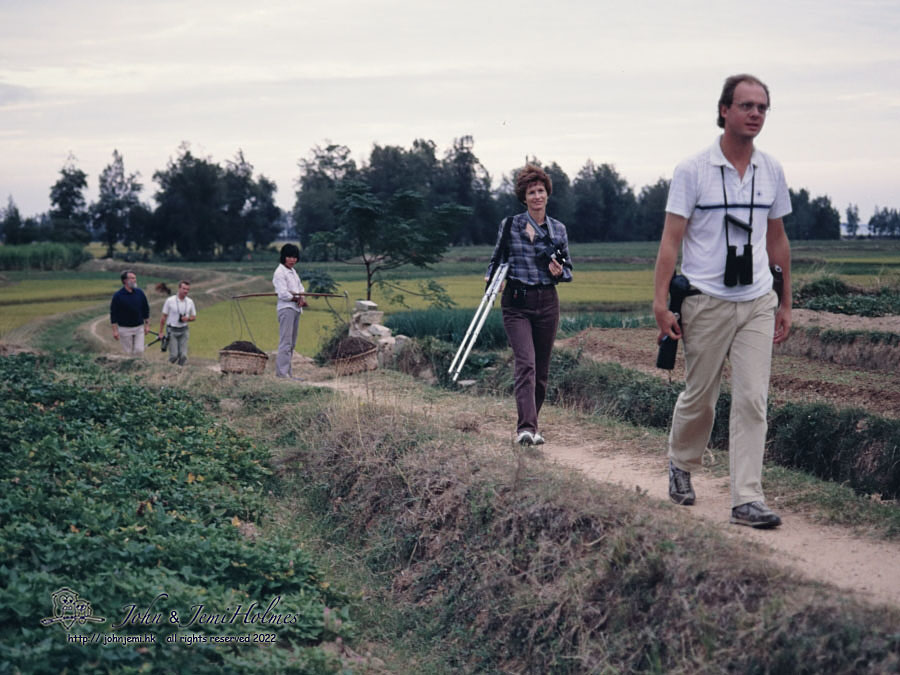
It took us TWO DAYS to get to Kuatun Village, near Wuyi. But, just getting there was part of the adventure.


We sailed out of Hong Kong on one of the overnight ferries, heading north towards Xiamen.  Here we are, off the coast of eastern Guangdong, scoping Streaked Shearwaters. This was a species only added to the “HK List” in 1985, but known to be “out there” from earlier yachting and ferry reports.


The following morning, sea-birding was interrupted by the timeless spectacle of a flotilla of square-sailed fishing sampans.


We docked at the port of Xiamen (formerly Amoy), with a view of the old buildings of the pre-1930 British Concession Island of Gulangyu. 


With a day to spend in Xiamen, we birded the fields and coastline near the university area.


Then, overnight to Nanping (northeast Fujian) by train.  Our carriages were pulled out of Xiamen Station by this handsome Datong steam locomotive. 


We found that steam was alive and well in northern Fujian.


A welcoming dance performance on the station platform 

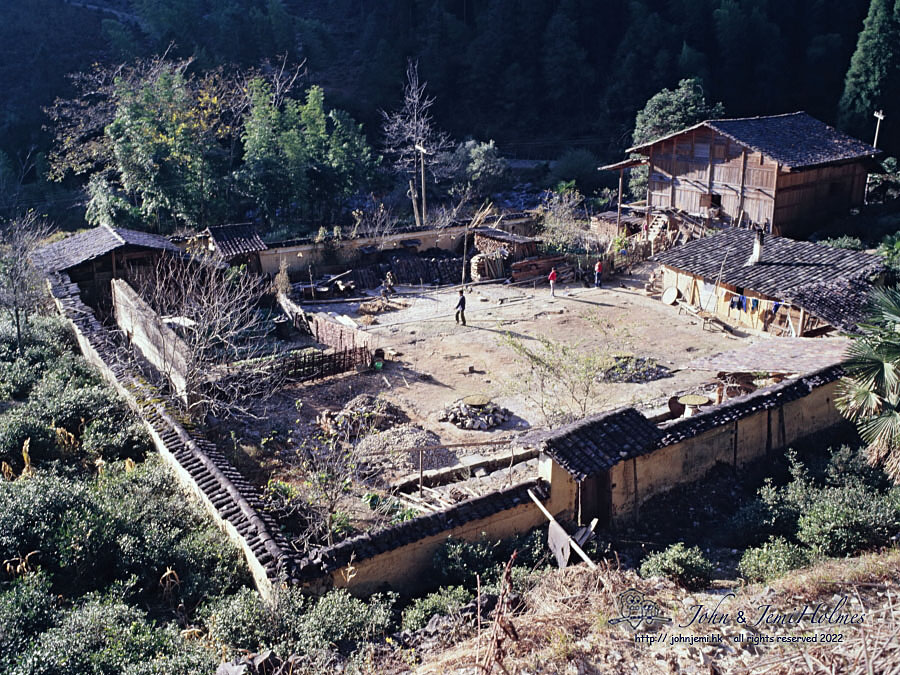
The village of Kuatun was the base for J D D LaTouche  (“A Handbook of the Birds of Eastern China”) in 1898, second only to Pere Armand David, who had been there in the autumn of 1873.


As a newbie birder this was this first place I ever saw Yellow-cheeked Tit and Speckled Piculet. My photographic efforts were centred on a 645 Bronica ETRS, so I had few “keepers” among my bird photos. 


The views along the road that followed the ridge that marks the boundary of Fujian and Jiangxi were spectacular. I revisited this road in 2007 with Lao Lin”, late bird guide from Nanchang (Jiangxi). 


Cabot's Tragopan (T. caboti) - a nifty east China endemic, if ever there was one...


We spent the last couple of nights at the Wuyi Scenic area, popular with domestic tourists even then.


Another lengthy train journey took us to the provincial capital, Fuzhou. 

On the the 9th floor of our oh-so-modern hotel, we were woken by the swaying of the building. An earthquake.  After an hour of standing in the chilly car park, we disregarded some minor cracks in the plaster and went back inside.  (Happily for us, there were no serious injuries damage in Fuzhou, the quake epicentre was across the Taiwan Strait, near Taipei).


We caught an early morning flight back to HK, after a week packed with things to remember.  


6 May 2019

East China Sea Cruise, - China to Japan seabirding, 30th April to 4th May 2019

Brown Booby - Sula leucogaster

On 30th April we sailed from Xiamen bound for Okinawa on the Costa Atlantica

On board were three Hong Kong would-be seabirders (Carrie Ma, Jemi and myself) and about two thousand mainland Chinese Golden Week merry-makers.

We intended to use the four night/three full days schedule to bird two days at sea north of Taiwan, - out and back - and get what birds we could on a very restricted "Tour" of Okinawa.

Here is the route (map by Carrie Ma) with the yellow areas "birdable" in daylight.


Last September we did a similar cruise, from Xiamen to Miyakojima. That time the ship was the Superstar Gemini.

Although the 3rd level deck of Costa Atlantica was spacious, there was no public area with a view of the sea surface to the front of the ship. The only view at the rear was at the 9th level. With space at the ship sides devoted to giving many cabins their own balcony, all round viewing opportunities on Costa Atlantica were more limited than on the earlier ship.

Plenty of deck space on level 3 - but no view front and rear.
It started raining as we left Xiamen (Fujian Province) and wet and windy decks the following morning (May 1st) meant that we were forbidden to go outside on the 3rd level. 

Ominous Xiamen rain clouds
We sneaked out anyway, but after an hour or so ship security staff led us back inside.

Inside “Costa Atlantica”

We ended up at the rear deck of the 9th level, where our only clear view of the sea was from next to the designated smokers’ area.

Most of the birds we saw were distant.  In fact it seemed like some species were actively avoiding the boat.

Here in HK bird photographers call distant bird specks on their image files “sesame seeds”.  Many of these are “sesame seed” images, greatly cropped.

Bulwer’s Petrel - Bulweria bulwerii

Brown Noddy - Anous stolidus

Sooty Tern - Onychoprion fuscatus

Streaked Shearwater - Calonectris leucomelas

Red-necked Phalarope - Phalaropus lobatus

Long-tailed Skua - Stercorarius longicaudus

Masked Booby - Sula dactylata

Red-footed Booby - Sula sula
A strong northerly wind came with the rain, and a few migrant passerines were seen, including a party of seven Yellow Wagtails which settled somewhere on the upper decks.
Eastern Yellow Wagtail - Motacilla tschutschensis

We soon noted that a Peregrine was hunting the birds resting about the ship. 

Peregrine Falcon - Falco peregrinus

Daiyoutai/Senkaku Islands
As we passed the Daiyoutai/Senkaku Islands, up to forty Brown Boobies circled high on the wind-sheltered side to hunt flying fish disturbed by the ship’s passage. In this respect,  the ship was attracting the hunting boobies.

Brown Boobies - Sula leucogaster (there's one under the water)

Brown Boobies - Sula leucogaster

Brown Boobies - Sula leucogaster
This time the flying fish got away.

There were also a few Masked Boobies, and a single (brown morph) Red-footed Booby.
Red-footed Booby - Sula sula

On May 2nd, after Immigration formalities, we all disembarked for the scheduled “Sight-seeing” coach trip on Okinawa.


Docked at Naha, Okinawa, Japan
We called briefly at Senaga Island.


It was a scenic spot with a few waders and co-operative Little Terns.

Little Tern - Sternula albifrons

Little Tern - Sternula albifrons

Little Tern - Sternula albifrons

Our second stop was at Shurijo Castle Park, where Blue Rock Thrushes were numerous and confiding.

Blue Rock Thrush - Monticola solitarius
Shopping was the main objective for many of our shipboard companions. Across the road from the first of three stores the tour coach visited, at Nishizaki, we found more waders on a pleasant little beach.


Nishizaki Beach

Pacific Golden Plover -Pluvialis fulva

Kentish Plover - Charadrius alexandrinus

"Ghost" Crab - Ocypode sp. ?
"Also seens" included Grey-tailed Tattler, Ruddy Turnstone and Whimbrel. 

Eventually we got back on board the Costa Atlantica, and a full day at sea (May 3rd ) saw us cover much of the same area as two days earlier, passing close to the north of Taiwan on our way back to the Chinese mainland.

With fine weather, we had unrestricted deck access. Carrie saw and photographed a Sperm Whale, and we all had brief glimpses of dolphins.

Flying fish sp.
From mid- to late morning the Brown Boobies were chasing flying fish again.... 

Brown Booby - Sula leucogaster

Brown Booby - Sula leucogaster

Brown Booby - Sula leucogaster

But later - after we left the disputed islands behind and entered the Taiwan Strait - there were no birds to be seen. 
Taipei - Matsu Islands Ferry

Northern Taiwan
It was a long afternoon as we examined various items of rubbish on the sea surface in the hope of discovering more birds.  

Sunset in the Taiwan Strait (May 3rd 2019)

I think that these trips are as instructive for what we didn't see, as well as what we actually saw.  So, no albatrosses or storm-petrels, but there were areas with regular appearances of Bulwer's Petrels and Brown Noddies, both of which might be breeding in the area.

Red-footed Booby is unusual in Japanese waters, but was probably attracted by the activity of the Brown Booby flock.

Thanks

Thanks  again to Carrie MA for planning and organising the trip !


Technical matters

An apology

Since the demise of Google+, although I have redone my Google profile, I am strangely unable to reply to comments on my own blog ! 
I'm working on it !